

Der Strumpf-Kompass
The Stocking Compass: Crisis & Consumption. A sociological view of what the German sock drawer reveals about the sociology of crisis


In the great ledger of German consumption, socks rarely get their own line. Yet, an analysis of Digital Demand from the hosiery market suggests that during the pandemic, was prone to bubbles in comfort, orderly rallies in sport, and a quiet, somewhat disturbing bull run in women’s fine tights.
To a logistics manager, the numbers tell a story of inventory optimisation. To a sociologist, however, they offer a granular view of how a “Risk Society”—to borrow Ulrich Beck’s term—processes a rupture in the everyday. The data suggest that when the ‘normal’ collapses, Germany retreats into a distinctively mix of risk aversion, rigid gender roles, and the secular ritual of the Spaziergang.
Gilded Cage
The most striking finding comes from a Digital Demand’s Female Signal, a composite of search intent for +100 concepts such as Feinstrumpfhosen (fine tights) and Halterlose (stay-ups). Before Covid-19, this market was noisy, driven by the whims of fashion and seasonality. During the pandemic, however, a volatility collapse occurred.
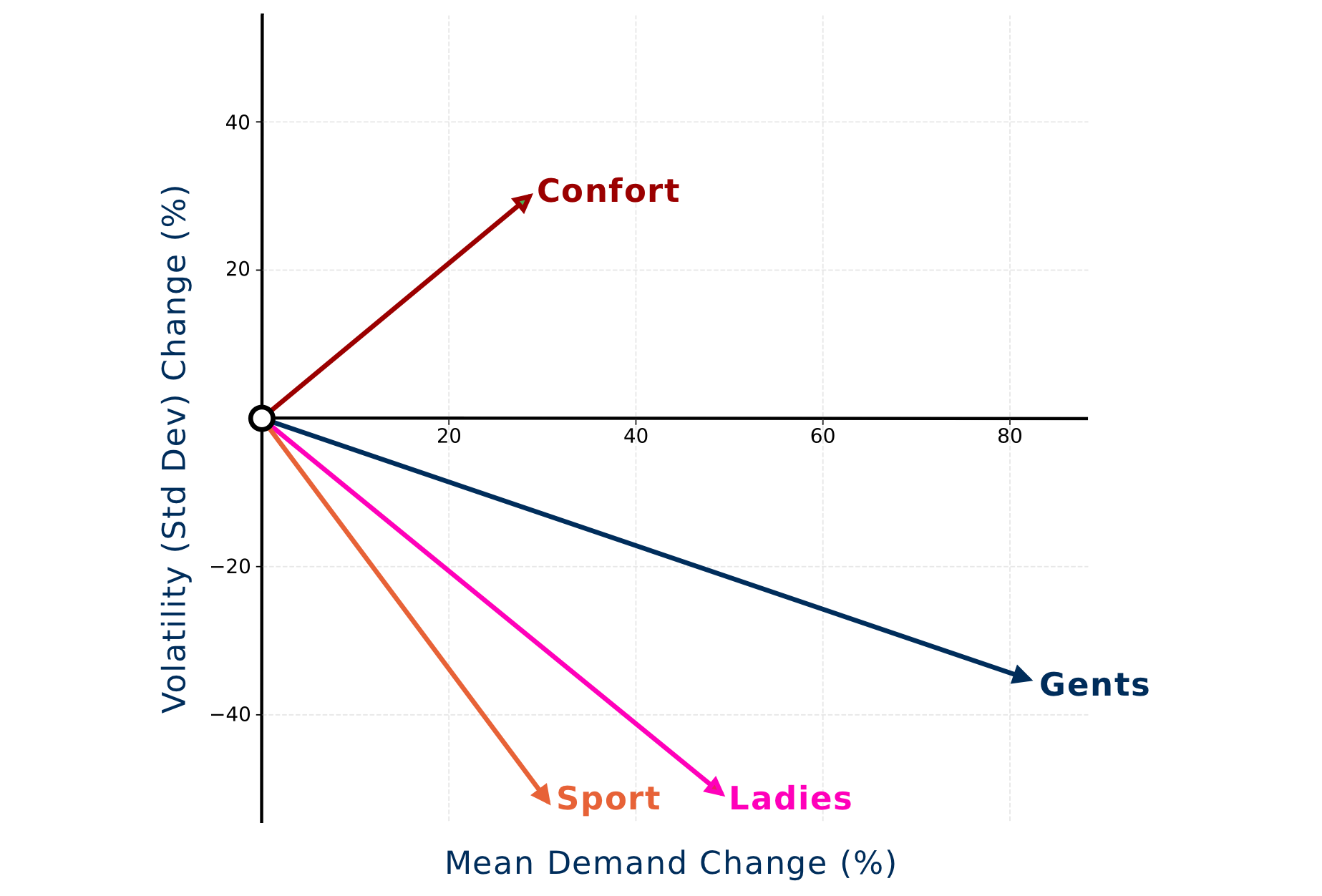
Technical analysis reveals that while average demand surged by 50% (Cohen’s d = 1.53), the standard deviation of that demand nearly halved. The coefficient of variation dropped from 0.34 to 0.11, moving this category into a supply-chain planners dream: growth and stability.
But sociologically, such extreme predictability is rarely a sign of liberty. A 76% reduction in variance suggests a massive homogenisation of experience. With schools closed and state care infrastructure shuttered, unpaid care work disproportionately fell to women. Predictable consumption was, in effect, the statistical footprint of a gilded cage. The luxury of browsing was stripped away by the relentless schedule of homeschooling; women bought what was needed, when it was needed, with unnerving regularity.
The Fortress
The male side of the drawer tells a different story. Intent for men’s socks surged by over 80%, with variance falling by about a third. German men, long satisfied with multipacks of anonymous black socks, suddenly became deliberate digital consumers. This signals the fortification of the male home office. While the female signal reflects the maintenance of the household, the male signal reflects its capitalization—the conversion of the home into a fortress of productivity.
However, the real drama lies in the ‘Comfort Index,’ tracking demand for materials like cashmere, alpaca, and merino. Here, the pattern reverses. Demand rose by 29%, but volatility (variance) soared by 70%.
This volatility as the seismograph of ‘German Angst’. Unlike the steady flow of daily necessities, the search for comfort was spasmodic, driven by infection waves and lockdown announcements. This was not a peaceful retreat into Hygge, but a frantic form of ‘cocooning’ as an immune response. Supply-chain algorithms detest this behaviour. Sociologists, meanwhile, recognise it simply as the material expression of panic.
Secular Liturgy
Finally, the Sport Index (running, wandern, compression gear and the like…) remained the picture of resilience. Digital Demand rose by 31%, yet volatility remained stable. Why did sport remain so consistent when comfort went chaotic? The answer lies in the Spaziergang (the stroll).
In Germany, walking is a secular liturgy, a way to order the mind. During lockdowns, it became the only permitted freedom. This resilience,nevertheless, was not evenly distributed. The ability to engage in this stabilising ritual depended heavily on access to green spaces, favouring the middle and upper classes in leafy neighbourhoods over those in dense urban centres. The stability of the Sport Index may, in fact, mask the immobility of the less fortunate.
Legacy of Variance
The data present a paradox. The ‘Anxious Stability’ identified by algorithms—high demand, low variance—was built on what Pierre Bourdieu might call “structural violence”: the invisible coercion of gendered care expectations. Yet, there is a distinctly German rationality at play: Werterhalt (value retention). In a crisis, buying durable, high-quality goods is a risk-management strategy.
The pandemic did not merely pause ‘normal’ life in Germany; it reorganized the social contract. Digital Demand reveals a society that bifurcated: An Anxious Stability of Predictability was built on the retraditionalization of gender roles and the standardization of the home-office life. On the other side, a High Volatility revealed a frantic attempt to buy emotional security through material goods.
As Germany emerged from the pandemic, supply chain managers lamented the return of “noise” and unpredictability. However, anthropologist welcomed it. The return of variance— serendipity, impulse, and the messy unpredictability of public life— signalled the end of the ‘gilded cage’ and the return of genuine social agency. The ‘Anxious Stability’ was a statistical mirage; true prosperity is found in the freedom to be unpredictable.