

Wärme Republik
The Anthropology of the Sock Drawer, what Germany’s Falke fetish reveals about a country that engineers even its socks
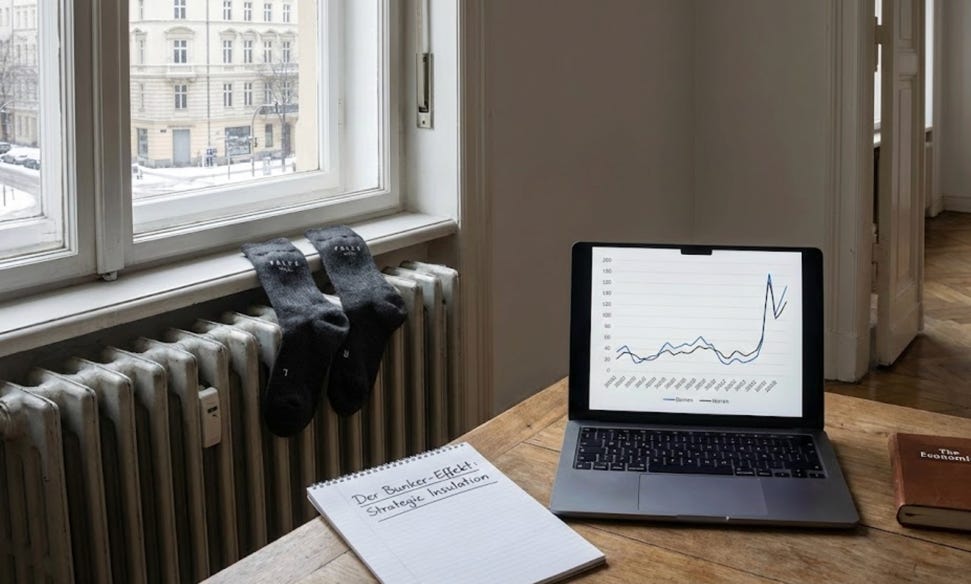
If you want to understand Germany, you could look at its constitutional court, its traffic-light coalitions or its current account surplus. Or you could look in the sock drawer.
Years of Digital Demand’s data for Falke, a century-old German maker of premium hosiery, provide an unusually precise view of how Germans think about comfort, quality and domestic order. Falke’s ‘Damen’ und ‘Herren’ lines move through the year with near-perfect synchronicity: the weekly correlation between women’s and men’s search intent is 0,935.  On the surface this looks like proof that one person—usually female—buys socks for everyone. Look closer, and you see something more interesting: a household procurement regime that treats clothing as equipment and warmth as policy.
This is not really a story about fashion. It is a story about Sachlichkeit—the German preference for things to be solid, appropriate and technically correct—even when those things are socks.
Chief Procurement Officer in a German Household
The Digital Demand supports a familiar picture: one person coordinates most purchases. Women account for 54 % of Falke’s premium search intent. Gender lines do not merely trend in the same direction; they move together week by week. That is unlikely if each gender were acting independently. It suggests a Chief Procurement Officer of the household who plans for everyone’s feet at once.
But the German man is not a passive passenger in all this. He is less an absent “phantom” than a specifications engineer. Falke sells models with designated left and right feet, compression zones, climate-regulating yarns and model names that sound faintly automotive (‘Airport’, ‘Running’). These are not marketed as fashion ornaments. They are sold as technical gear that promises Passform (fit) and Funktionalität (function). The wearer may not place the order, but he helps define the tolerances: no slipping, no sagging, no premature holes.
In Bourdieu’s terms, what is being bought is not simply warmth, but a shared Habitus: a household identity that values things that “work properly”.
Not bourgeois snobbery, but bürgerliche Ernsthaftigkeit
Falke behaves very differently from the rest of the wardrobe. Correlations with Amazon are mid-range (0,44), with fast fashion low (0,30) and with sports brands essentially zero.  Premium hosiery, in other words, is neither a trend item nor a commodity. Earlier analyses were tempted to see this as a form of low-key status display: the sock as a “Veblen consumable”.
That misreads the German psyche. Veblen goods are meant to be seen. Falke socks are hidden under trouser legs. They do not scream wealth; they whisper that the wearer believes in Werterhalt—preserving value through durability.
This is inconspicuous consumption with a Protestant ethic. Buying a €20 sock that lasts years is not framed as indulgence, but as fiscal and moral prudence. Purchasing half a dozen cheap pairs that disintegrate by Easter feels like joining the Wegwerfgesellschaft, the throwaway society that Germans profess to hate.
Seen this way, Falke sits in the same mental drawer as Miele washing machines or a well-maintained diesel estate car: not glamorous, but obviously correct. The consumer is not trying to impress the neighbours. He (and more often she) is trying to impress an internal auditor who insists that things should be built—and bought—to last.
Insulation as statecraft
Digital Demand time series read like a history of German crises rendered in merino wool. The Ladies segment grows at around 9,4 % a year, Gentsat 9,2 %, but the real story lies in the spikes and dips. 
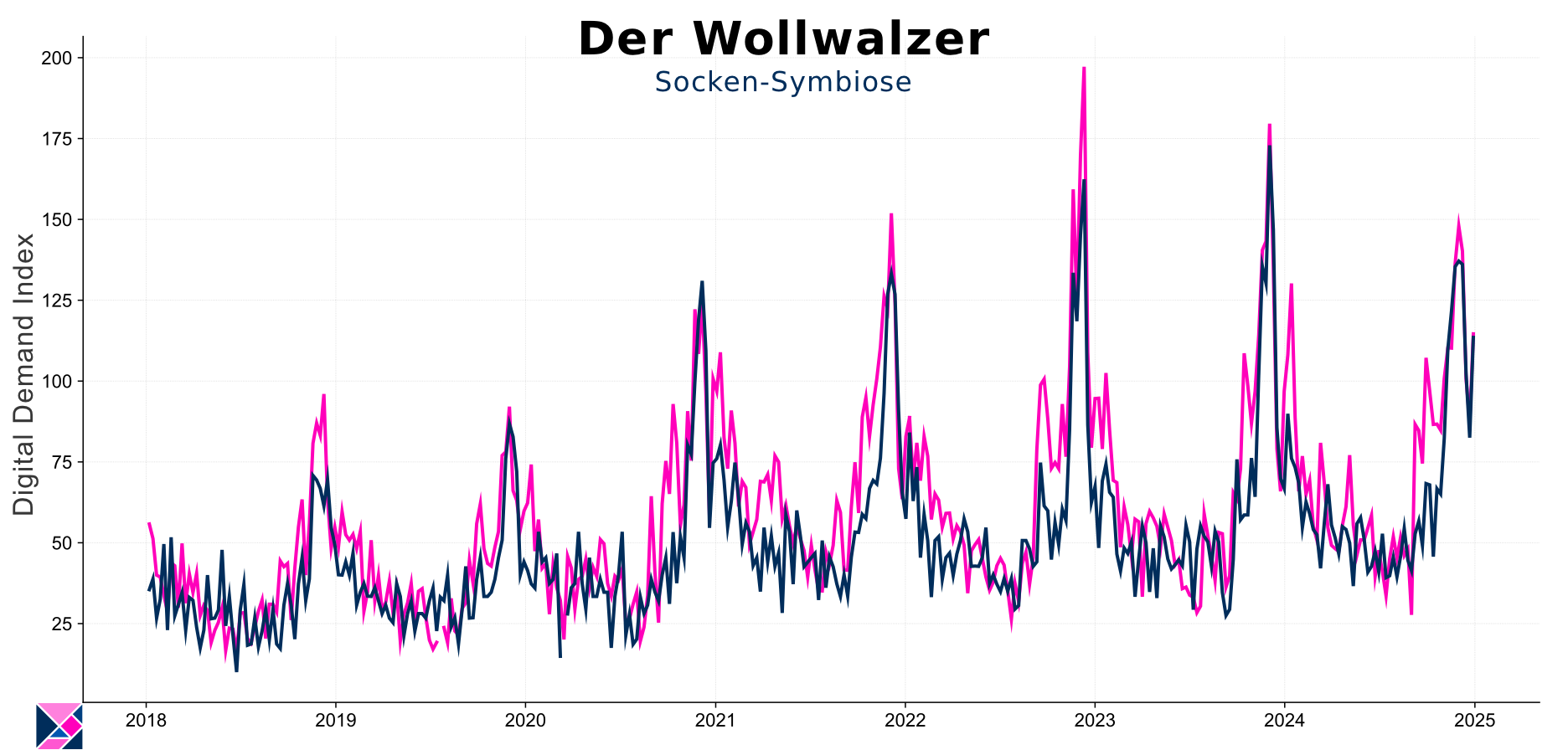
Three structural breaks stand out. The first is climatic. During the scorching summer of 2018, the index for women’s hosiery collapsed to 0.59 of the seasonal mean. As sandals replaced wool, the market priced in the reality of climate change: a structural bear market for insulation.
The second shock was digital. As lockdowns bit and the traditional Weihnachtsmärkte were shuttered, consumption was forced online. Search Intent in November 2020 nearly doubled year-on-year, while December 2021 marked an all-time peak. This suggests a demographic capitulation: Germany’s silver surfers, traditionally loyal to the department store, were forced to master e-commerce. A decade of digital adoption was compressed into two winters.
The third, and most telling, shift occurred in 2022. As Russian gas flows dwindled and Berlin warned of a freezing winter, September—usually a dormant month for the wool trade—saw a statistically significant spike. This was not seasonal replenishment; it was “pre-insulation.”
Observers might mistake this for the Lipstick Effect, where consumers splash out on small indulgences during downturns. But in the Teutonic context, this is a category error. A €30 pair of thermal socks is not an emotional consolation; it is a defensive capital expenditure. Unable to hedge global gas prices, the rational household hedges its own thermal efficiency. Call it Bunker Effect: when the state advises lowering the thermostat, the prudent response in a draughty Altbau is to reinforce the textile layer.
The tyranny—and subtlety—of the calendar
The hosiery business remains brutally seasonal. December is a giant, with a seasonal index of 1,66 for women and 1,82 for men—up to 82 % above an average month for Herren.  Men’s socks are the canonical safe gift: emotionally neutral, size-forgiving and easily wrapped. Falke’s balance sheet depends heavily on Q4 going to plan.
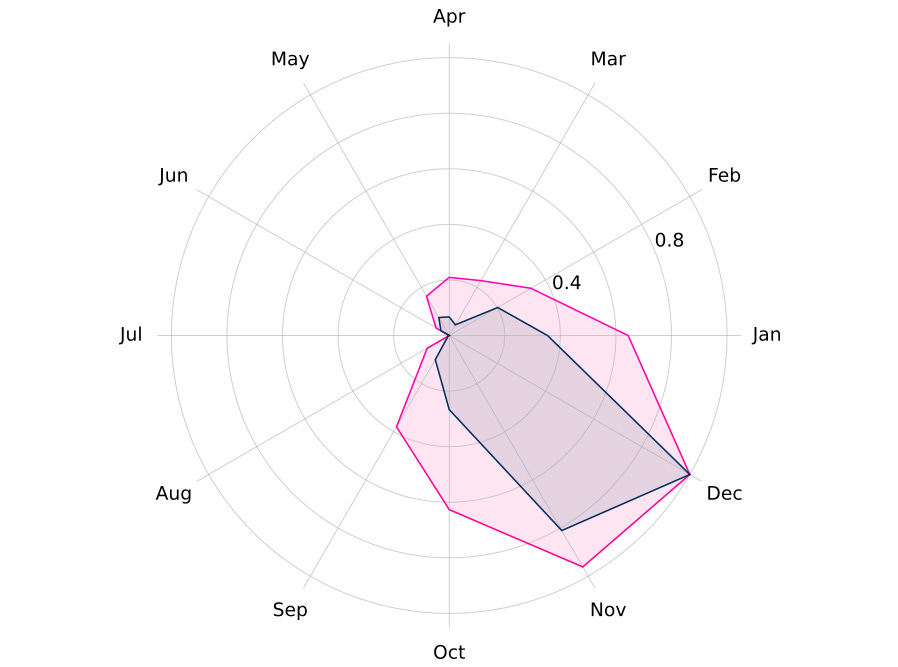
Yet the more instructive month is October. After a lethargic summer and a half-hearted September, women’s search index jumps from 0,99 to 1,26—the single sharpest transition in the year.  This is when self-purchase begins: the first mornings when the kitchen floor feels cold, and nobody is thinking about gifts yet.
The calendar divides the category into two separate rituals:
October: infrastructure procurement. The household stocks up for its own comfort. Messaging around “climate control”, durability and fit is most persuasive.
December: gift diplomacy. The same product is reframed as a token of care for others. Packaging, colours and multi-packs suddenly matter more than temperature ratings.
The Digital Demand also punctures a cherished marketing fantasy: “Back to school”. August and September sit well below the annual average, with a negative impact of up to 20 % for men.  German parents fret about pencil cases not premium socks.
Technocrats in knitwear
All this reveals a culture that does not regard clothing as decoration so much as infrastructure. A sock is judged less on whether it is on trend and more on whether it behaves. The same technocratic instincts that produce carefully calibrated heating systems and intricate rubbish-sorting schemes are visible in the sock drawer.
This technocratization of clothing is gendered, but not in the simple way advertising clichés suggest. Women perform the visible labour of procurement: monitoring the state of drawers, timing purchases against weather and calendars, navigating e-commerce interfaces. Men contribute a subtler labour: defining acceptable performance thresholds and vetoing anything that feels “flimsy”. The high correlation between Damen and Herren lines is the signature of joint rationality, not unilateral pampering. In this sense, Falke’s Digital Demand track a specifically German compromise between tradition and modernity:
Division of labour inside the home remains asymmetrical. Lockdowns widened the ladies-to-gents search ratio to 1,21 at the peak, as women shouldered the digitalisation of household shopping. 
German gender politics in miniature: a country that talks the language of equality while quietly relying on traditional, feminised ‘invisible work’—list-making, replenishing, keeping track of who needs new wool socks before the first frost.
Norms of quality are stubbornly old-fashioned. Falke’s decoupling from fast fashion and online retail indicates a refusal to treat certain items as interchangeable. 
Coolly instrumental response to shocks. A heatwave depresses socks; an energy shock pulls demand forward; a pandemic accelerates channel migration.
From sock drawer to Bundesrepublik
What, then, does the Falke’s Digital Demand say about Germany more broadly?
First, that this is a society which still believes in stability via material correctness. When other pillars wobble—coalition governments, gas contracts, export markets—Germans retreat to things that can be made and maintained “properly”: a well-engineered boiler, a well-insulated window, and, apparently, a well-knit sock.
Second, that its consumer culture is built on equipment, not ornament. The appeal of Falke lies not in being seen, but in knowing that one is equipped for drafts, commutes and long days in formal shoes. The sock becomes a small, recurring affirmation that the world, or at least the part of it touching one’s skin, still obeys reasonable standards.
Third, that its domestic order is quietly conservative. The invisible work that keeps drawers stocked and logistics aligned with the calendar still falls heavily on women, especially in times of disruption. The pandemic and energy crisis did not reinvent gender roles; they re-entrenched them, albeit in more digital form.
Finally, the Digital Demand hints at why Germany often appears slow to “modernise” its consumer habits. When your sense of dignity rests on things working for a long time, you are less eager to experiment with disposable novelties. You buy once, correctly, and then you get on with life.
In an age of streaming subscriptions and software updates, a pair of high-quality socks offers something increasingly rare: a problem solved for several winters at once. In that sense, the most anthropologically accurate description of Falke might not be “premium hosiery” at all. It is the textile equivalent of a balanced budget—unshowy, carefully calibrated and deeply reassuring to those who believe that, at the end of the day, numbers (and toes) should add up.